The Local Story
Cradled at over 1,000 metres beneath the cloud-capped slopes of the Tay Con Linh range, Xa Phin is a tranquil Red Dao village famed for traditional palm-leaf stilt roofs cloaked in thick natural moss, centuries-old Shan Tuyet tea groves, and terraced rice that ripens late in mid-October. The mountain ascent from Phuong Tien is steep and twisty, so ride a low-gear manual motorbike or travel in a high-clearance vehicle, stroll softly on narrow stone footpaths, and savour warm artisan tea beside evening wood fires.
In this guide
Perched at over 1,000 metres above sea level beneath the towering Tay Con Linh range, Xa Phin is a peaceful village inhabited entirely by the Red Dao ethnic community in the Ha Giang town region. Often celebrated as a miniature Hoang Su Phi just an hour away from the provincial centre, this remote enclave preserves a tranquil highland rhythm far removed from the bustling motorbike routes.
Palm thatch cloaked in living moss
The most defining signature of Xa Phin is its traditional architecture. The Dao villagers build sturdy stilt homes thatched with thick layers of dried palm leaves. In the perpetual dampness, cool mists, and year-round mountain drizzles of Tay Con Linh, dense velvet-green moss gradually blankets every rooftop over decades. In early mornings, wood smoke curls gently through moss-covered gables as mountain clouds drift past, creating an ethereal tableau reminiscent of an ancient fairytale.
Ancient Shan Tuyet tea trees
Surrounding the hamlet are centuries-old Shan Tuyet tea trees with gnarled, mossy trunks that root deeply into the rocky mountain soil. For generations, local families have scaled these giant trees to hand-pick tender buds blanketed in white fuzz, roasting them over open wood stoves to produce a fragrant, honey-amber brew renowned across northern Vietnam.
Four seasons beneath the Tay Con Linh range
The cool, moisture-rich mountain microclimate gives Xa Phin a distinctive four-season rhythm:
- Spring tea flushes (January to March): Heavy clouds swirl across ancient forest canopies as centuries-old Shan Tuyet tea trees sprout tender downy buds. Dao families climb giant tea trunks for the year's first artisan harvest.
- Summer emerald moss (April to June): Enjoying high-elevation coolness, the village becomes a serene mountain retreat. Rain flushes turn the thick velvet moss blanket across palm-leaf roofs to its most vivid emerald green.
- Late golden harvest (July to October): Unlike limestone valleys that harvest early, Xa Phin terraces are planted late and reach their golden harvest peak around mid-October, cascading down mountainsides beside deep green tea groves.

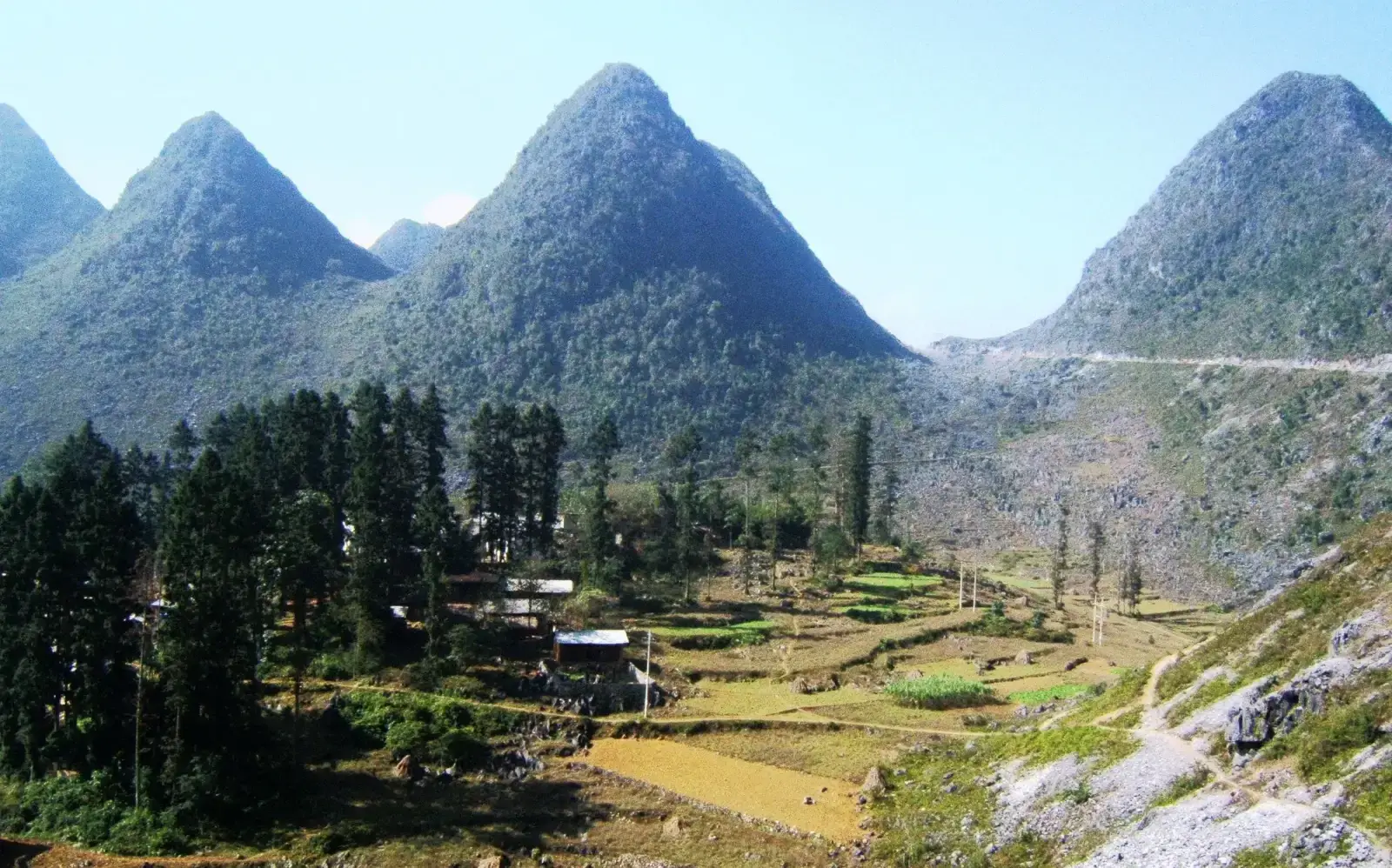
Turtle Hill at Sa Phin, with National Route 4C on the left
- Winter hearths and mists (November to December): Temperatures drop and soft mountain mists drift continuously through village lanes. Wood hearths inside mossy stilt homes burn around the clock, filling the air with fragrant woodsmoke and honeyed tea aromas.
Golden harvest under mountain clouds
Unlike the lower valleys along the Loop, rice paddies in Xa Phin ripen considerably later in the autumn calendar. Carved into steep gradients, the terraced tiers turn a brilliant glowing gold around mid-October. The sight of golden grain cascading down mountain ridges alongside tranquil streams makes it an unforgettable retreat for slow travellers.
Village etiquette and mountain road safety
Xa Phin remains a peaceful agricultural settlement and ancestral homeland of the Red Dao:
- Drive cautiously on steep grades: The 10-kilometre concrete ascent from Phuong Tien features continuous sharp switchbacks; use a manual or semi-automatic motorbike in first or second gear, and avoid low-clearance passenger cars.
- Protect living roof moss: Never climb onto roofs or attempt to detach patches of living moss; these lush green layers are heritage features nurtured over decades of natural damp weather.
- Respect household peace: Stroll mindfully along stone lanes, greet elders with a respectful nod, and ask permission before taking portraits of villagers.
Practical Observations
- Mid-October offers the most breathtaking terraced rice vistas when fields turn bright gold.
- The concrete road climbing from Phuong Tien is steep and narrow; ride in low gear on a manual motorbike or travel in a high-clearance car.
- Mornings can be chilly and damp year-round; bring a light windbreaker and comfortable walking shoes.
Related story
The Dong Van Karst Plateau: what a UNESCO Global Geopark means for your trip
Most of the Ha Giang Loop runs through a UNESCO Global Geopark of 2,356 km². What that title means, what you will see, and how to travel it well.
Good to know before you go
What makes Xa Phin village unique compared to other Ha Giang villages?
Xa Phin is celebrated for its centuries-old palm-leaf roofs thickly covered in natural green moss, thriving in the cool mountain climate of Tay Con Linh, alongside terraced rice fields that ripen in mid-October.
How difficult is the road to Xa Phin?
The road is paved in concrete but narrow and steep with sharp switchbacks. It requires confident riding skills on a semi-automatic motorbike or a skilled driver in a sturdy passenger car.

